










郷土館の三つの宝 The Three Treasures of Kyodokan
Treasures! No.1「“Saiseikan” Calligraphy by Sanjo Sanetomi」
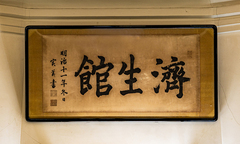
The plaque reading “Saiseikan” displayed near the ceiling, was written by Sanjo Sanetomi, Grand Minister of State during the Meiji period and the individual who gave the hospital its name. The sign displayed on the front of the former Saiseikan Hospital Main Building was created based on this original calligraphy.
The calligraphy was reportedly requested by Hasegawa Motoyoshi, the hospital’s first director, who traveled from Yamagata to Tokyo and arranged the commission through personal connections.
The name “Saiseikan” means “a hall for saving lives.” It is believed to reflect the founding philosophy of an earlier private hospital in Tendo, which emphasized training physicians and advancing the practice of saving lives.
The term saisei (“saving lives”) frequently appeared in Edo-period medical texts and book titles, such as “Saisei Sanpo” by Sugita Seikei and “Gen-shi Saiseiho” by Gen Yowa.
Together with the “Portrait of Hippocrates” and the other treasures preserved at the Yamagata City Local History Museum, this plaque reflects the efforts made during the Meiji period to establish Saiseikan Hospital as a modern medical institution worthy of national pride.
Treasures! No.2 「Kaitai Shinsho and Compendium of Materia Medica」
Kaitai Shinsho (The New Book of Anatomy)
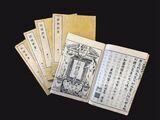
Published in 1774, Kaitai Shinsho was a groundbreaking Japanese translation of a Dutch anatomical text by Sugita Genpaku and his colleagues. Based on the illustrated anatomy book “Ontleedkundige Tafelen” by the German physician Johann Adam Kulmus, it brought major innovations to Japanese medicine. The illustrations were created by Odano Naotake, an artist from the Akita domain and a friend of Sugita Genpaku, who is said to have studied Western painting under Hiraga Gennai.
The translation process was extremely difficult, sometimes requiring several days to translate a single line. Nevertheless, the translators completed all 249 pages over the course of three and a half years. The project began after Sugita Genpaku, Maeno Ryotaku, and others observed the dissection of an executed criminal at the Kozukappara execution grounds in Edo on March 4, 1771. They were astonished by how accurately the anatomical illustrations matched the actual human body and resolved on the spot to translate the book into Japanese.
Compendium of Materia Medica (Ben Cao Gang Mu [Ch.], Honzo Komoku [Jp.])
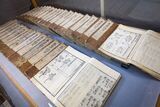
Compendium of Materia Medica (Ben Cao Gang Mu) is a famous Chinese medical text compiled in the 16th century (Ming dynasty) by the physician and naturalist Li Shizhen. Based on approximately 26 years of research, it documents around 1,900 medicinal plants, animals, and minerals.
Its importance extends beyond pharmacology and traditional Chinese medicine. The book systematically reorganized earlier medical knowledge while adding new observations and classifications, giving it great value as a work of natural history as well.
Unlike earlier materia medica texts, which categorized substances according to medicinal potency, Ben Cao Gang Mu organized materials into 16 categories based on their characteristics, including: water, earth, metals, stones, grasses, grains, fruits, trees, insects, fish, birds, animals, and humans. Each entry includes names, origins, textual references, properties, medicinal effects, and prescriptions. This classification method greatly influenced later encyclopedic and scientific works and is considered one of the book’s most innovative features.
The text also had a major impact in Japan. After its publication in Ming China in 1596, it was brought to Nagasaki around 1607 and is said to have been presented to Tokugawa Ieyasu, who reportedly kept it by his bedside for frequent reading. Numerous Japanese editions were later published.
The edition displayed here, Kosei Honzo Komoku, is a complete Japanese-printed edition published in 1637 by Noda Yajiemon of Kyoto. All 52 volumes are complete and in perfect condition. An inscription at the end of the final volume records that, in 1868 (231 years after its publication), a man named Eguchi Shunnan of Ojirafu-mura (present-day Kaminoyama City) purchased the set for three silver ryo.
Treasures! No.3「Portrait of Hippocrates」
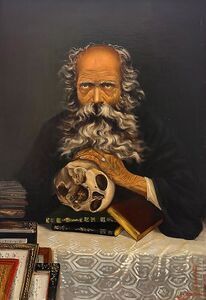
This painting was created in 1879 to commemorate the opening of Saiseikan Hospital and was formerly displayed in the second-floor lecture hall. The artist was Yamada Seisho, a Western-style painter who studied at Takahashi Yuichi’s art school, “Tenkaisha”. He later worked at the Faculty of Medicine at the University of Tokyo, where he was involved in producing anatomical illustrations.
The figure depicted is Hippocrates, the ancient Greek physician known as the “Father of Medicine.” Until the Edo period, Japanese physicians traditionally displayed images of Shennong, the Chinese deity of medicine and agriculture. However, with the introduction of Western medicine—particularly German medicine—portraits of Hippocrates came to symbolize modern Western medical practice.
The Saiseikan Hospital portrait was created within this historical context. Its production was closely connected to Mishima Michitsune, the first governor of Yamagata Prefecture. While inspecting hospitals in Tokyo during plans for the prefectural hospital, he saw a portrait of Hippocrates displayed at the University of Tokyo and decided that such an image would be fitting for Saiseikan as both a hospital and a center for medical education. Mishima is said to have commissioned Yamada Seisho to create this work.
Yamada’s Portrait of Hippocrates was later exhibited as a reference work at the 10th Anniversary Exhibition of the Meiji Art Society in 1898. It was praised as an important example illustrating the introduction of Western painting techniques to Japan from the late Edo period through the founding of the Meiji Art Society.
This work is considered the oldest surviving oil portrait of Hippocrates in Japan and is highly valued for both its realism and technical excellence.
より良いウェブサイトにするために、ページのご感想をお聞かせください。
このページに関するお問い合わせ
文化スポーツ部文化創造都市課
〒990-8540 山形市旅篭町二丁目3番25号
電話番号:023-641-1212(代表)
ファクス番号:023-624-9618
bunka@city.yamagata-yamagata.lg.jp